
Awesome Oscillator (AO)
The Awesome Oscillator (AO) is an indicator developed by Bill Williams that measures market momentum and helps identify shifts in sentiment between buyers and sellers. It is used to identify trend reversals, confirm current movements, and find entry/exit points.
How the Awesome Oscillator Works
Section titled “How the Awesome Oscillator Works”The AO is calculated as the difference between Simple Moving Averages:
- SMA with a period of 5,
- SMA with a period of 34,
both of which are taken from the median prices (the average value between the candle’s High and Low).
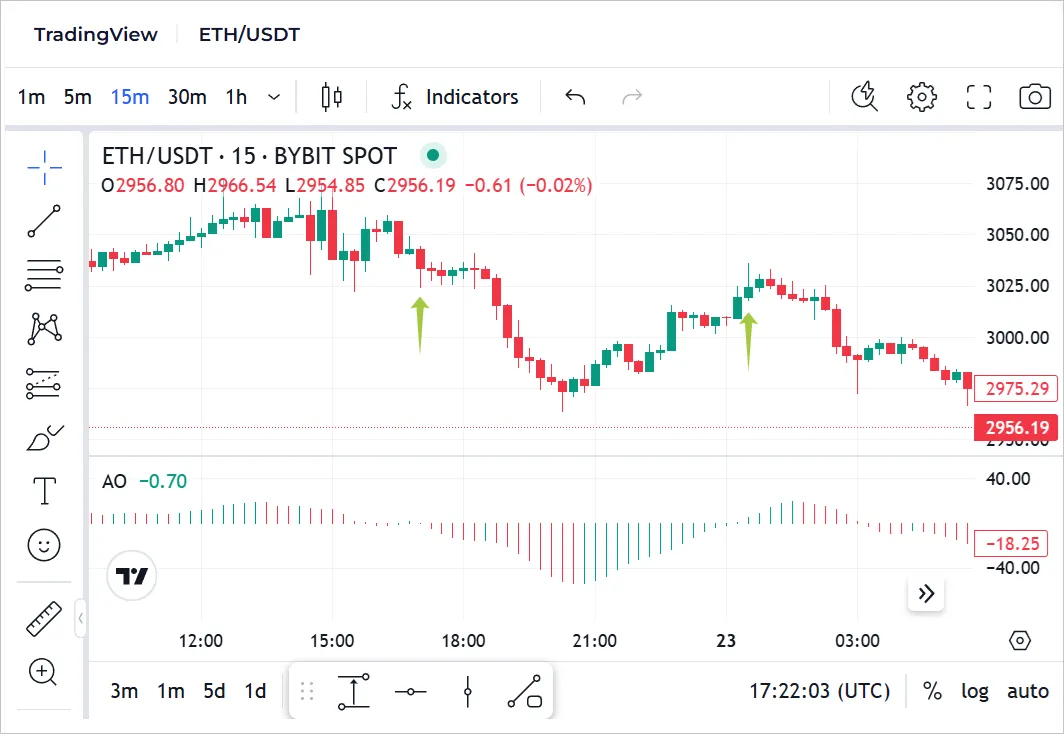
The indicator is displayed as a histogram:
- Values above 0 → buyers are dominating (signal for Long).
- Values below 0 → sellers are dominating (signal for Short).
- Crossing the 0 line → possible trend reversal.

AO Signals
Section titled “AO Signals”-
Zero Line Crossing
- Crossing from below to above → possible growth.
- Crossing from above to below → possible decline.
-
Green and Red Bars
- Green bar longer than the previous one → strengthening of the bullish movement.
- Red bar longer than the previous one → strengthening of the bearish movement.
-
Twin Peaks (or Twin lows)
- Two lows below zero, where the second is higher than the first → Buy-signal.
- Two highs above zero, where the second is lower than the first → Sell-signal.
How to use in trading
Section titled “How to use in trading”- Use AO as a filter to confirm a trend.
- Open trades when the indicator crosses zero and signals from other indicators (for example, RSI or MACD) coincide.
- Use on different timeframes: on higher timeframes to determine the trend, on lower timeframes for entry points.
Limitations
Section titled “Limitations”- AO is a lagging indicator, as it’s based on Moving Averages.
- It can generate numerous false signals during sideways movements.
- It’s best to use AO in combination with other indicators or filters.
Summary
Section titled “Summary”The Awesome Oscillator is an intuitive momentum tool that makes market sentiment visible through its histogram. In Veles bots, it works best as a trend confirmation filter — combining AO zero-line crossovers with RSI or MACD significantly reduces false signals in sideways conditions.