Exchange Fees
Exchange trading fees are charged when an order is executed and are calculated based on its volume. Creating and canceling an order is free — the fee is charged only upon execution, regardless of whether the trade results in a profit or a loss. Even in the event of a position liquidation, the exchange will still charge a fee.
If the trade volume is large and the fixed profit is too small (e.g., P&L = 0.2%), the fee can “eat up” the entire profit, resulting in a negative outcome.
Types of Trading Fees
Section titled “Types of Trading Fees”- Maker — for limit orders, usually lower.
- Taker — for market orders, almost always higher.
Check your exchange’s documentation for the exact rates.
How Veles Bot Uses Orders
Section titled “How Veles Bot Uses Orders”Limit orders:
- offset > 0;
- grid in “Simple” and “Custom” modes;
- simple profit by percentage offset;
- multi-take profits.
Market orders:
- offset = 0 or “Market” mode;
- grid in “Signal” mode;
- simple stop-loss;
- break-even stop-loss (Custom profit mode);
- exit by indicator signal (Signal mode).
Paying Fees on Exchanges
Section titled “Paying Fees on Exchanges”- Some exchanges (Binance, Yobit, Gate) use an internal token to pay fees, e.g., BNB on Binance. Paying in native tokens often comes with a discount (Binance offers 25%).
- Other exchanges deduct fees directly from the trade result.
Spot Trading Specifics
Section titled “Spot Trading Specifics”The fee is charged in the base currency of the trade. For example, when buying BTC for USDT, the fee is taken in BTC, leaving you with slightly less BTC than the bot purchased.
To prevent the bot from stopping with an “Insufficient balance” error when setting a take-profit:
- buy coins in advance for about ~0.3% of the bot’s deposit;
- keep them outside active trades — the fee will be deducted from this reserve.
Example 1 — Long Trading
Section titled “Example 1 — Long Trading”The bot buys 1 ETH, fee 0.1% = 0.001 ETH. Your balance will be 0.999 ETH. If the amount is small (0.01 ETH), the fee is rounded according to the exchange’s rules, and the remainder may get “stuck” on the balance. For example, for ETH/USDT with a 4-decimal precision, 0.00999 ETH will round to 0.0099 ETH, leaving 0.00009 ETH unused.
These leftovers can be:
- accumulated;
- converted into the exchange token (BNB, BIT, etc.).
Example 2 — Short Trading
Section titled “Example 2 — Short Trading”In SHORT mode, leftovers are not an issue: the fee is taken from the received currency. For example, selling 1 ETH for 2000 USDT with a 2 USDT fee still leaves enough funds to cover the fee even with a 0.5% profit target (1990 USDT).
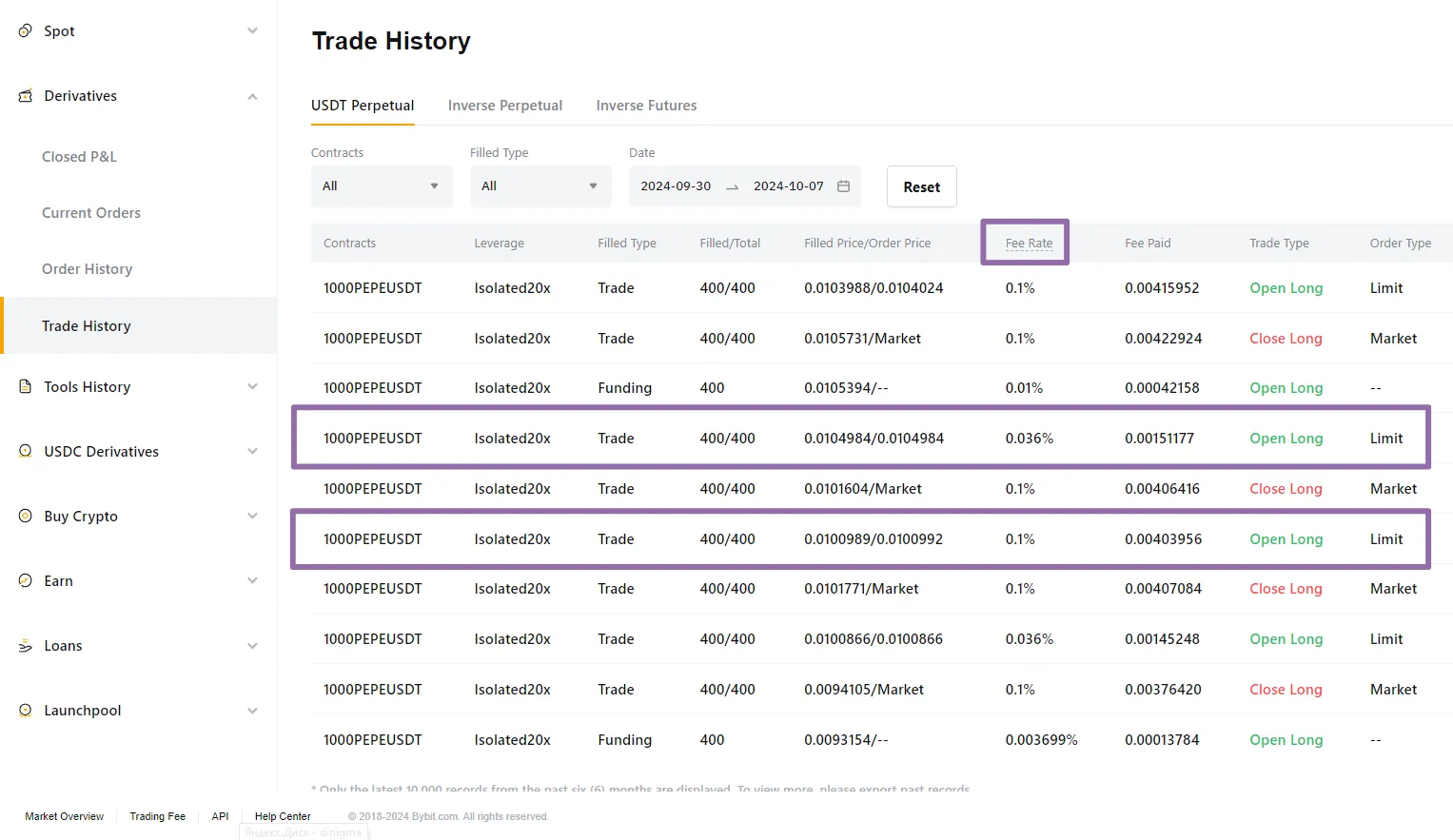
Where to Check Fee Rates
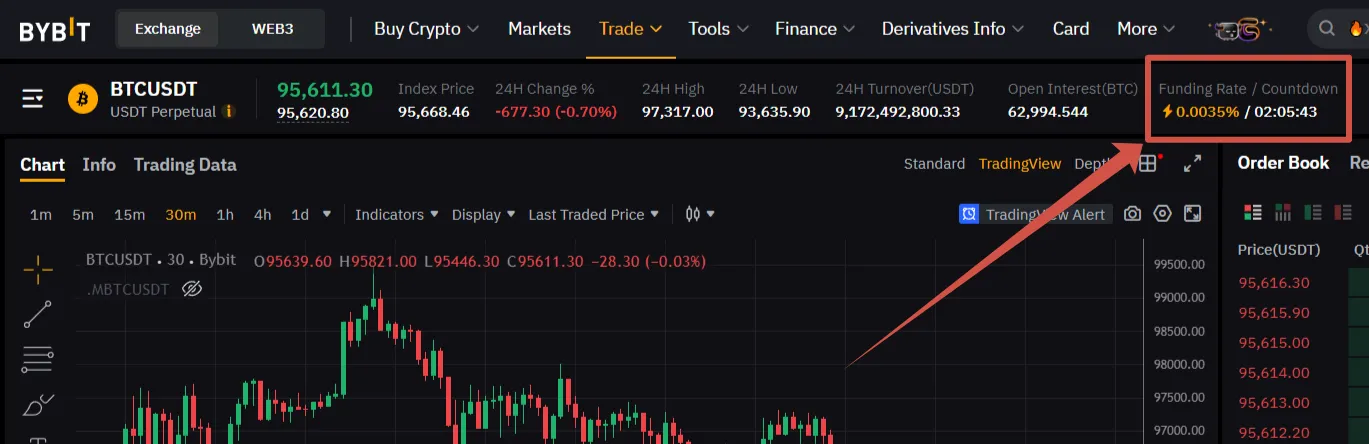
Section titled “Where to Check Fee Rates”Funding Fee
Section titled “Funding Fee”When trading futures, the exchange charges a funding fee every few hours. The rate can be:
- positive (you pay),
- negative (you receive).
The amount is included in the position’s Realized PnL.