
Hull Moving Average (HMA)
The Hull Moving Average (HMA) is a technical indicator that calculates the average price over a specified period, but does so faster and more accurately than traditional SMAs or EMAs.
The main goal of the HMA is to reduce lag while maintaining a smooth line. This makes the indicator more sensitive to price changes and helps identify entry and exit points earlier.
How HMA Works
Section titled “How HMA Works”Unlike Simple Moving Averages, HMA uses Weighted Moving Averages (WMA). This allows it to place greater emphasis on recent price values and reduce response lag.
How it works:
- The WMA (Weighted Moving Average) is calculated for half the period.
- The WMA is calculated for the full period.
- The difference between them is multiplied by a coefficient and smoothed with another WMA.
The result is a smooth line that barely lags the price.
HMA Signals
Section titled “HMA Signals”The indicator can be used to understand the current trend:
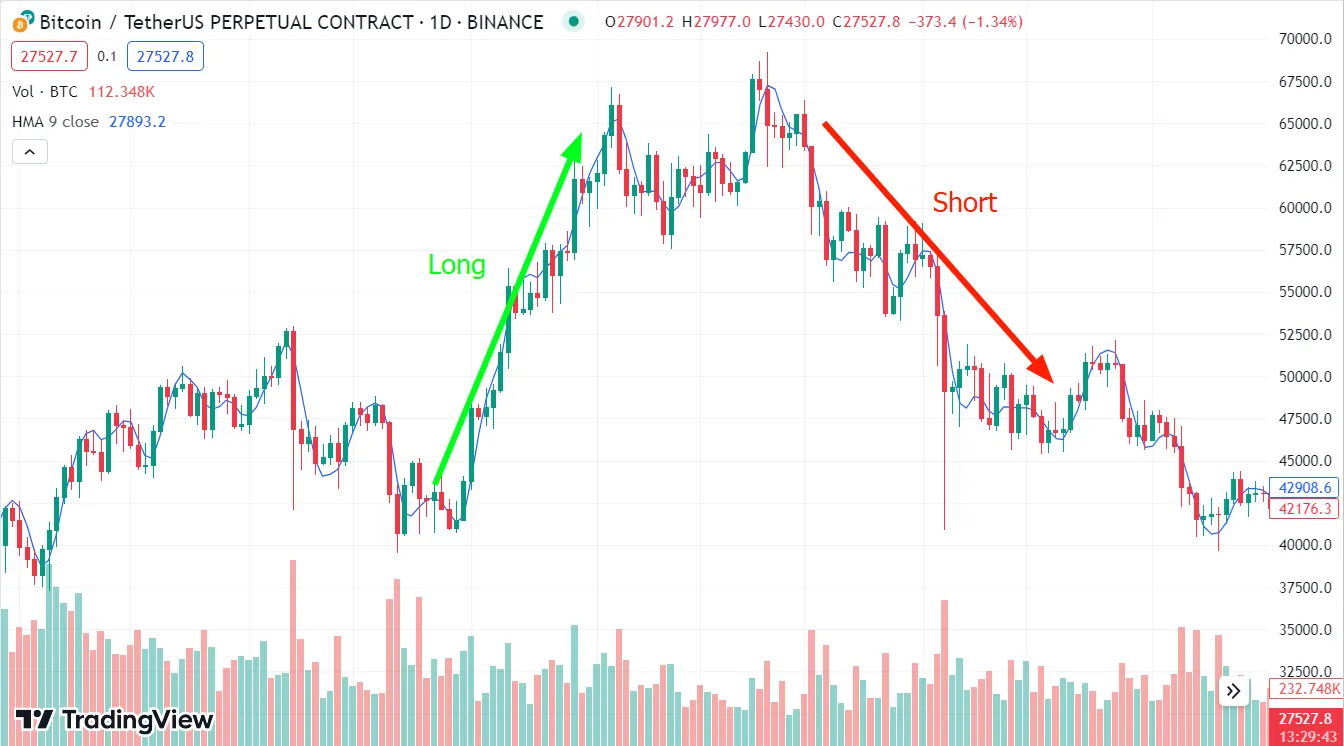
- Price above HMA → the market is considered bullish → Buy-signal (open Long or close Short).
- Price below HMA → the market is considered bearish → Sell-signal (open Short or close Long).
Advantages of HMA over SMA and EMA
Section titled “Advantages of HMA over SMA and EMA”- Reacts faster than SMA (Simple Moving Average).
- Maintains a smooth line, unlike EMA, which may get “jerky” over short intervals.
- Works well as a trend filter – helps filter out false signals from oscillators.
Using in Veles Bots
Section titled “Using in Veles Bots”In the Veles bot settings, you can set a condition based on the HMA value. This allows you to:
- filter entry points (for example, only enter trades in the direction of the trend),
- combine HMA with other indicators (RSI, MACD) to improve signal accuracy.
Limitations
Section titled “Limitations”- HMA can react too quickly to price fluctuations on very short timeframes, increasing false signals.
- Like all trend-following indicators, HMA lags at the start of new trends and cannot predict reversals.
- Best used as a directional filter combined with an oscillator (RSI, CCI) rather than as a sole entry signal.
Summary
Section titled “Summary”The Hull Moving Average is an improved version of classic Moving Averages. It minimizes lag, stays smooth, and allows for faster response to price changes. When combined with other indicators, the Hull Moving Average becomes a reliable tool for algorithmic strategies in Veles.