
Stochastic
The Stochastic Oscillator is a popular oscillator that evaluates the current closing price relative to the price range for a selected period. It shows the speed and direction of price change, helps identify overbought/oversold zones, and signals reversals.
The indicator consists of two lines:
- %K (Fast Line) — the current price position relative to the range for the selected period.
- %D (Slow Line) — a Moving Average of %K, which smooths out fluctuations.
The Veles platform offers two types of stochastics: fast and slow.
Fast Stochastic
Section titled “Fast Stochastic”- Uses 5 periods to calculate %K.
- Very sensitive to price changes.
- Provides more signals, but also more “noise”.
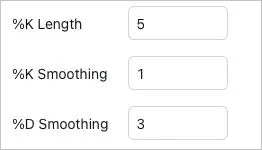
Slow Stochastic
Section titled “Slow Stochastic”- Calculates %K based on 14 periods.
- Additionally smooths out fluctuations using a Moving Average.
- Less prone to false signals and suitable for longer-term trading.
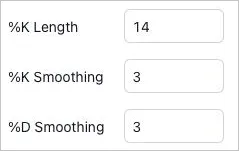
Stochastic Filters in Veles
Section titled “Stochastic Filters in Veles”Two filter types are available for each stochastic:
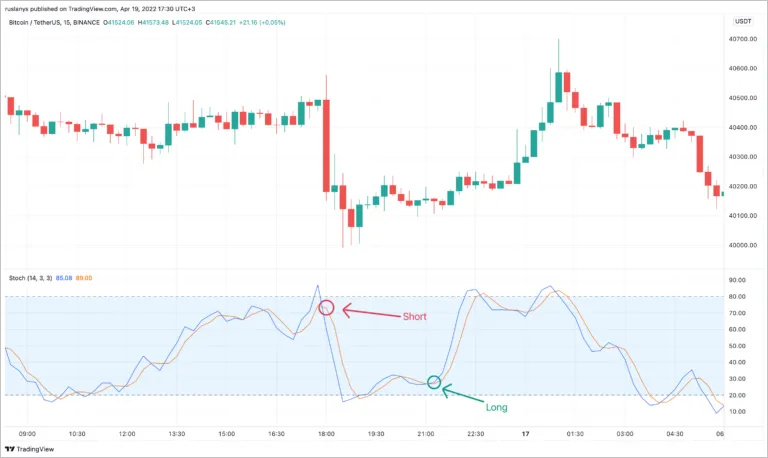
1. Line Crossover
Section titled “1. Line Crossover”- K crosses D from top to bottom → Sell-signal (open Short or close Long).
- K crosses D from bottom to top → Buy-signal (open Long or close Short).
2. Overbought and Oversold Levels
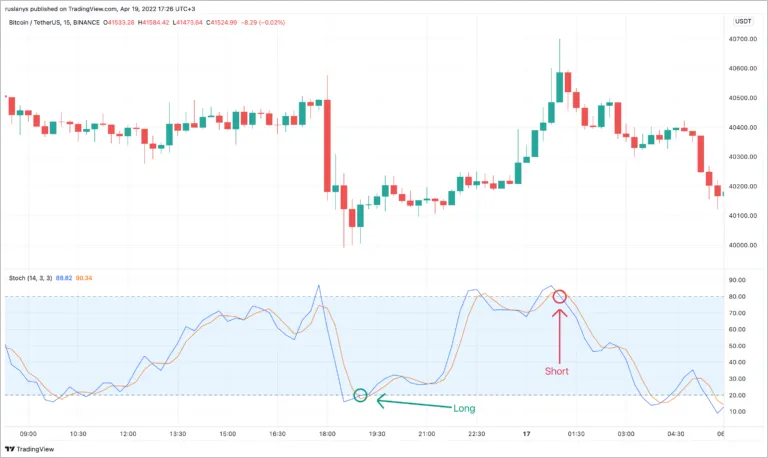
Section titled “2. Overbought and Oversold Levels”- Both lines crossing level 20 from bottom to top → Buy signal (open Long or close Short).
- Both lines crossing level 80 from top to bottom → Sell signal (open Short or close Long).
How to use Stochastic
Section titled “How to use Stochastic”- Trend entry — use K and D crossover signals in the direction of the main trend.
- Signal filtering — combine Stochastic with other indicators (RSI, MACD, SMA, EMA).
- Timeframe selection — on shorter timeframes, Stochastic generates many signals, while on higher timeframes signals are more reliable.
Limitations
Section titled “Limitations”- Stochastic often gives false signals during periods of low volatility.
- Can hang in overbought or oversold zones for a long time.
- Works best in sideways movements and when trading from support/resistance levels.
⚠ Before using the indicator, we recommend backtesting its settings to ensure the strategy suits your trading style.
Summary
Section titled “Summary”The Stochastic Oscillator is a proven tool for identifying momentum shifts and overbought/oversold extremes. In Veles bots, both the Fast and Slow variants are available — Fast for more frequent signals on lower timeframes, Slow for more reliable signals on higher ones. Combine with trend filters to reduce false entries during strong directional moves.